


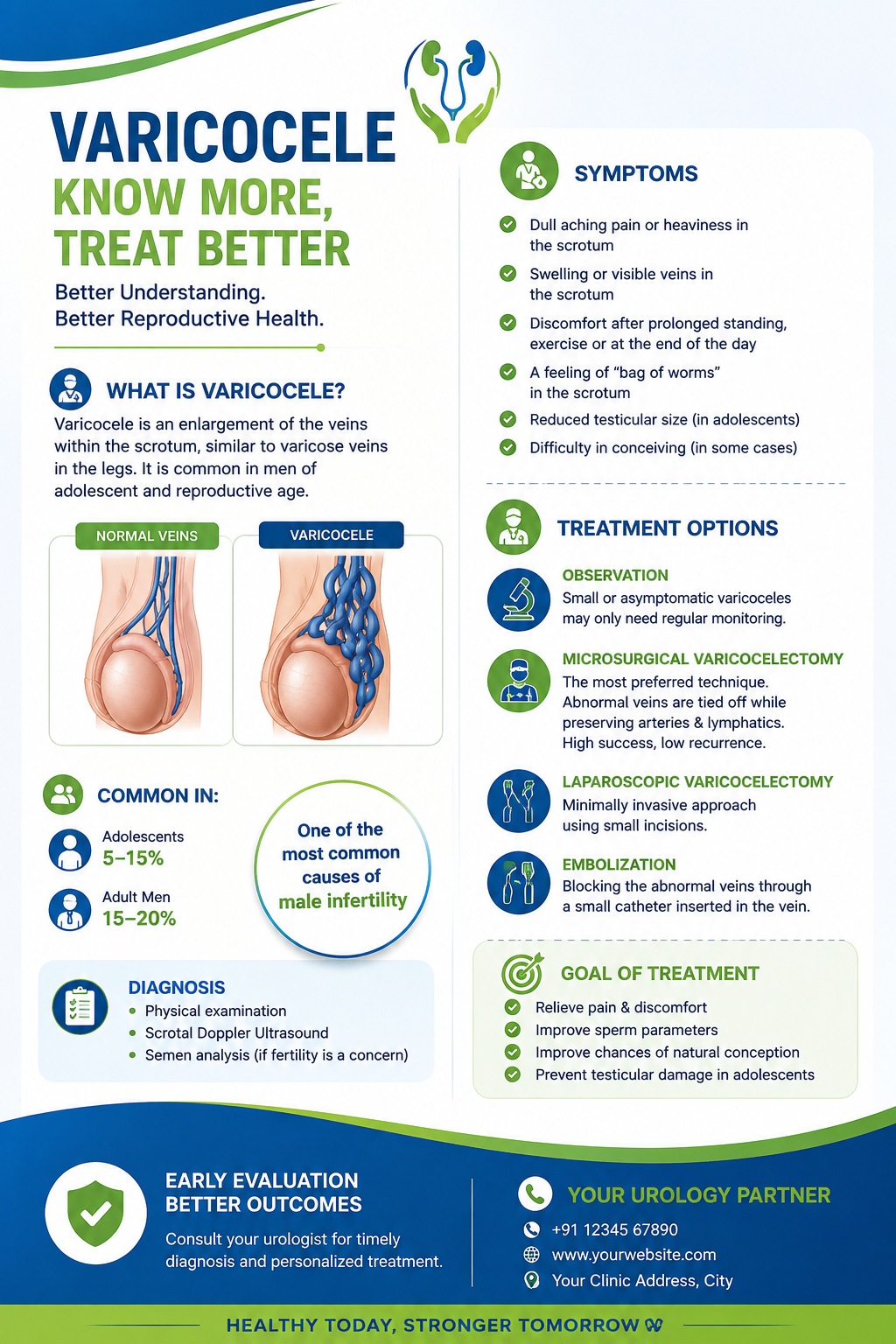
A varicocele is an enlargement of the veins within the scrotum, similar to varicose veins in the legs. It most commonly occurs on the left side and may develop gradually, particularly during adolescence or adulthood.
Varicocele is common and may be completely symptom-free. However, in some men it can cause discomfort, testicular growth problems, or contribute to abnormal sperm production and infertility.
What are the Symptoms of Varicocele?
Some men have no symptoms. When symptoms occur, they may include:
- A dull, aching or dragging pain in the scrotum
- Heaviness or discomfort that increases after prolonged standing or physical activity
- Visible or palpable enlarged veins in the scrotum
- A feeling of swelling or fullness in the scrotum
- Difference in testicular size, particularly in adolescents
- Difficulty conceiving or abnormal semen parameters
A typical varicocele may feel like a “bag of worms” when standing.
Does Varicocele Cause Infertility?
Varicocele can be associated with reduced sperm production and impaired sperm quality in some men. However, not every man with varicocele is infertile.
If infertility is a concern, evaluation may include a clinical examination, semen analysis and, when appropriate, scrotal Doppler ultrasound and hormonal testing.
How is Varicocele Diagnosed?
Diagnosis usually begins with a physical examination by a urologist.
Depending on the situation, your doctor may recommend:
- Scrotal examination while standing and lying down
- Assessment during straining
- Scrotal Doppler ultrasound
- Semen analysis when fertility is a concern
- Hormonal evaluation in selected patients
When Does Varicocele Need Treatment?
Treatment is not necessary for every varicocele.
Treatment may be considered when there is:
- Persistent or troublesome scrotal pain
- Abnormal semen parameters in a man being evaluated for infertility
- Testicular growth or size abnormality in an adolescent
- Other clinically significant findings determined by the urologist
The decision should be individualized according to symptoms, examination findings, fertility goals and testicular function.
Treatment Options
1. Observation
Small or asymptomatic varicoceles may simply be monitored. Your urologist may recommend periodic examination and, when appropriate, semen analysis or ultrasound.
2. Microsurgical Varicocelectomy
Microsurgical varicocelectomy is a commonly used surgical treatment. The abnormal veins are identified and ligated while preserving important structures such as the testicular artery and lymphatic vessels.
3. Laparoscopic Varicocelectomy
In selected patients, the veins can be treated using a laparoscopic approach.
4. Embolization
An interventional radiologist can sometimes treat the varicocele by blocking the abnormal veins through a catheter-based procedure.
What Happens After Treatment?
Improvement in pain can occur after treatment. In men treated for infertility, improvement in semen parameters may take several months because sperm production requires time.
Your urologist will advise you regarding follow-up examination and semen analysis when appropriate.
When Should You See a Urologist?
Consult a urologist if you notice:
- Persistent scrotal pain or heaviness
- Enlarged veins in the scrotum
- A difference in testicular size
- Difficulty conceiving
- Abnormal semen analysis
- A new scrotal swelling or lump
Important
Not every scrotal swelling is a varicocele. Any new or unexplained scrotal lump, swelling or pain should be evaluated by a qualified urologist.
Your reproductive health deserves proper evaluation and individualized treatment.