


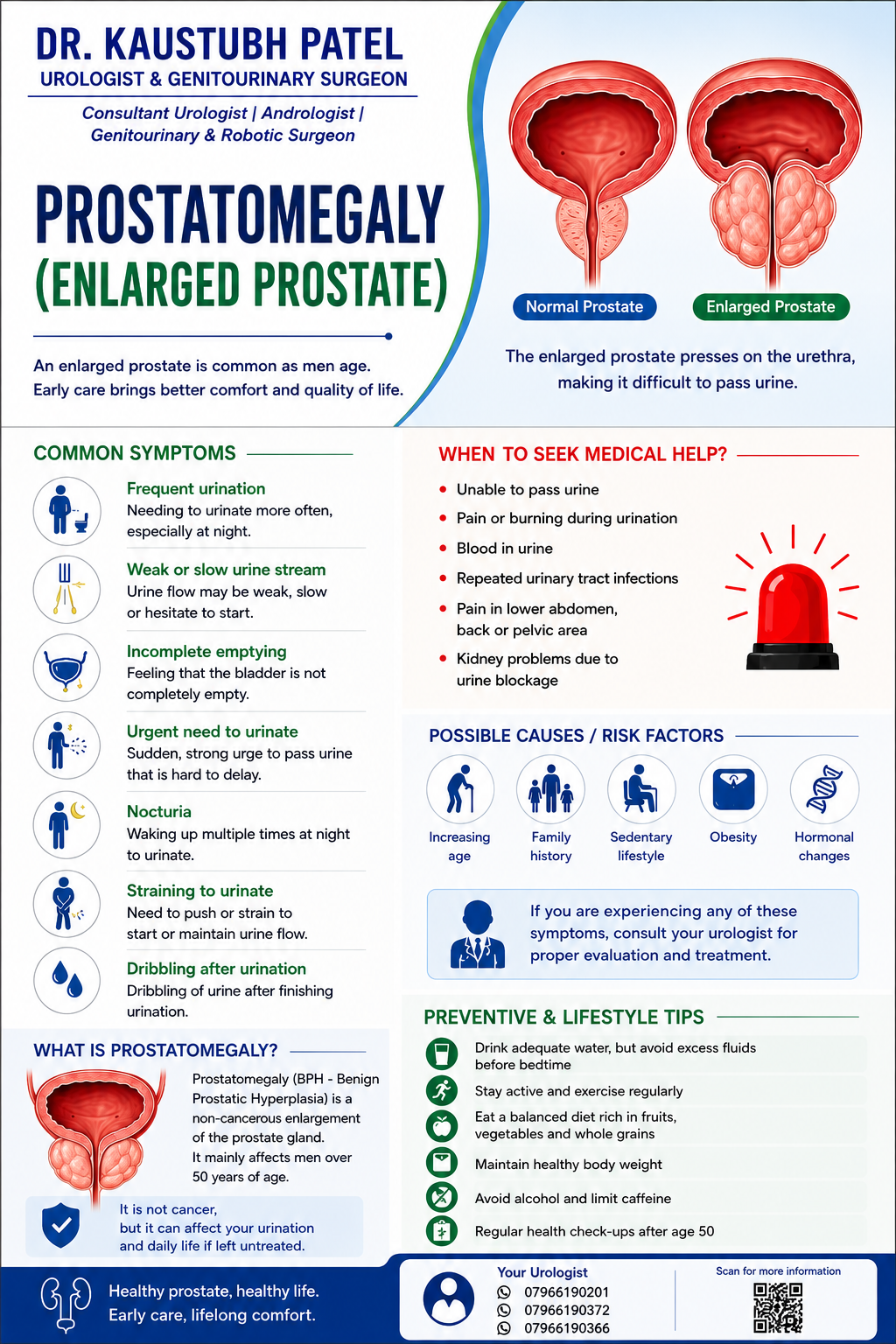
As men grow older, the prostate commonly becomes enlarged. This condition is called benign prostatic hyperplasia (BPH).
BPH is not prostate cancer. However, an enlarged prostate can compress the urethra and interfere with normal urine flow.
What is the prostate?
The prostate is a gland located below the urinary bladder. The urethra, which carries urine from the bladder, passes through the prostate.
As the prostate enlarges, it may narrow the urinary passage.
Common symptoms of an enlarged prostate
Symptoms can include:
- Frequent urination
- Urgency to urinate
- Getting up repeatedly at night
- Difficulty starting urination
- Weak urinary stream
- Intermittent urine flow
- Straining to urinate
- Feeling that the bladder has not emptied completely
- Dribbling after urination
These symptoms are commonly referred to as lower urinary tract symptoms (LUTS).
Does every enlarged prostate require treatment?
No.
Treatment depends on the severity of symptoms, their effect on quality of life, prostate and bladder findings, urinary flow, residual urine and other clinical factors.
Some men with mild symptoms may be managed with observation and lifestyle measures.
Medicines for BPH
Depending on the patient's condition, doctors may prescribe medicines such as:
- Alpha-blockers
- 5-alpha-reductase inhibitors
- Combination therapy
- Other medicines for selected bladder symptoms
Medication selection should be individualized.
When is surgery considered?
Surgery may be considered when:
- Symptoms remain troublesome despite medication
- Recurrent urinary retention occurs
- Repeated urinary infections develop
- There is bladder stone formation
- Significant bleeding is associated with BPH
- Upper urinary tract/kidney problems develop
- The patient prefers a procedural treatment after discussing options
Modern surgical treatments
Several procedures are available today, including:
TURP: Transurethral resection of the prostate.
HoLEP: Holmium laser enucleation of the prostate. This technique can treat a wide range of prostate sizes and uses laser energy to remove obstructing prostate tissue.
Other minimally invasive and laser procedures may also be appropriate depending on prostate anatomy, size, patient's health and surgeon expertise.
BPH is not prostate cancer
An important point is that BPH and prostate cancer are different conditions.
However, urinary symptoms alone cannot reliably distinguish between them. PSA testing and other investigations may be appropriate depending on the patient's age, risk factors and clinical situation. PSA is not cancer-specific and may also be elevated in benign prostate enlargement and prostatitis.
Can BPH damage the kidneys?
Severe untreated obstruction can, in some patients, lead to urinary retention, recurrent infection and deterioration of the urinary tract.
Therefore, persistent urinary symptoms should not simply be considered a normal part of ageing.
When should you see a urologist?
You should seek medical evaluation if you have:
- Increasing difficulty passing urine
- Weak urinary stream
- Repeated night-time urination
- Blood in urine
- Recurrent urinary infections
- Inability to pass urine
- Persistent bladder discomfort
Final message
An enlarged prostate is common and highly treatable. Modern medicines and minimally invasive procedures allow treatment to be tailored to each patient.
If urinary symptoms are affecting your sleep, daily activities or quality of life, a urological evaluation can help identify the cause and appropriate treatment.