


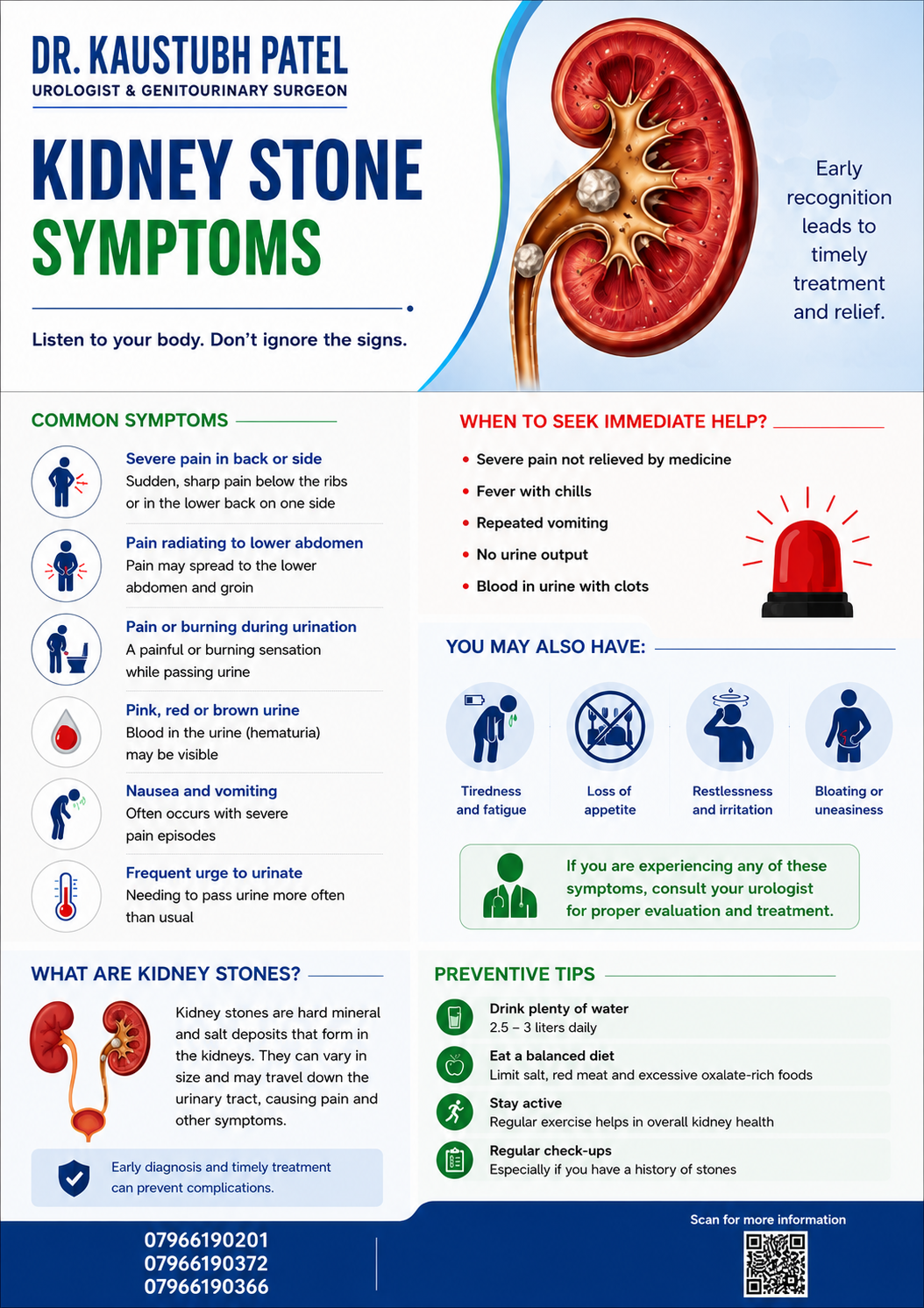
Kidney stones are one of the most common problems treated by urologists. A kidney stone may remain in the kidney without causing symptoms, or it may move into the ureter and cause severe pain, vomiting, blood in the urine or urinary obstruction.
Fortunately, modern urology offers several minimally invasive treatments for kidney stones. The three commonly discussed procedures are ESWL, ureteroscopy (URS/RIRS), and PCNL.
The best treatment is not the same for every patient. Stone size, location, composition, anatomy, kidney function, infection and previous treatment all influence the choice.
What is ESWL?
ESWL (Extracorporeal Shock Wave Lithotripsy) uses focused shock waves from outside the body to break the stone into smaller fragments. These fragments can then pass through the urinary tract.
ESWL is completely non-invasive because no instrument is inserted into the urinary tract.
Its effectiveness depends on factors such as stone size, location, composition, body habitus and the ability to accurately focus the shock waves on the stone.
Advantages of ESWL:
- No surgical incision
- Usually an outpatient procedure
- Relatively quick recovery
- Useful for appropriately selected kidney and ureteric stones
However, some patients may require more than one treatment session.
What is URS/RIRS?
During ureteroscopy, a small telescope is passed through the urinary passage into the ureter or kidney.
For kidney stones, flexible ureteroscopy is commonly called RIRS (Retrograde Intrarenal Surgery).
The stone can be fragmented using a laser and the fragments removed or allowed to pass naturally.
One important advantage of URS is that it often provides a higher chance of becoming stone-free with a single procedure compared with SWL, although it is an invasive procedure and has its own risks.
What is PCNL?
PCNL (Percutaneous Nephrolithotomy) is generally used for larger or complex kidney stones.
A small tract is created through the skin directly into the kidney. A nephroscope is then introduced and the stone is fragmented and removed.
PCNL remains an important standard treatment for large renal calculi, particularly stones larger than approximately 2 cm and complex/staghorn stones.
ESWL vs URS vs PCNL
| Treatment | Typical role | Main advantage |
|---|---|---|
| ESWL | Selected smaller stones | Non-invasive |
| URS/RIRS | Ureteric and many renal stones | High stone-free rate, minimally invasive |
| PCNL | Large/complex renal stones | Excellent clearance of large stone burden |
There is no single "best" procedure for every kidney stone.
The 2026 EAU Urolithiasis Guidelines emphasize individualized selection based on stone characteristics and patient factors.
When should a kidney stone be treated?
Treatment may be recommended when a stone causes:
- Recurrent or severe pain
- Urinary obstruction
- Infection
- Blood in the urine
- Increasing stone size
- Reduced kidney function
- Recurrent urinary problems
- Significant patient-related concerns or preference
Final message
Modern stone surgery allows most kidney and ureteric stones to be treated without traditional open surgery.
The right procedure depends on the individual patient and the characteristics of the stone. A urologist can evaluate the CT scan/ultrasound, stone size and location and recommend the safest and most effective option.
Important: Fever, chills and severe pain associated with urinary obstruction can represent an emergency and require urgent medical assessment.